Best Drinkware for Open Shelving at Home
Open shelving makes every glass, cup, and carafe part of the room's visual composition. The best drinkware for open shelving earns that visibility: it creates a sense of order from across the kitchen, feels substantial in the hand, and performs beautifully when guests arrive or the first coffee is poured.
This is not a case for displaying every vessel you own. It is an opportunity to edit your drinkware as intentionally as you would a dining table or bar cart. A few cohesive silhouettes can give open shelves a composed, lived-in character. The wrong mix can make even a generous kitchen feel crowded.
Start With a Collection, Not Individual Pieces
Open shelving rewards repetition. When glasses share a similar profile, material, or color story, they read as a deliberate collection rather than a storage solution left exposed. That does not mean every piece must match exactly. A wine glass, highball, and champagne flute can sit together beautifully when they share clean proportions and a consistent level of refinement.
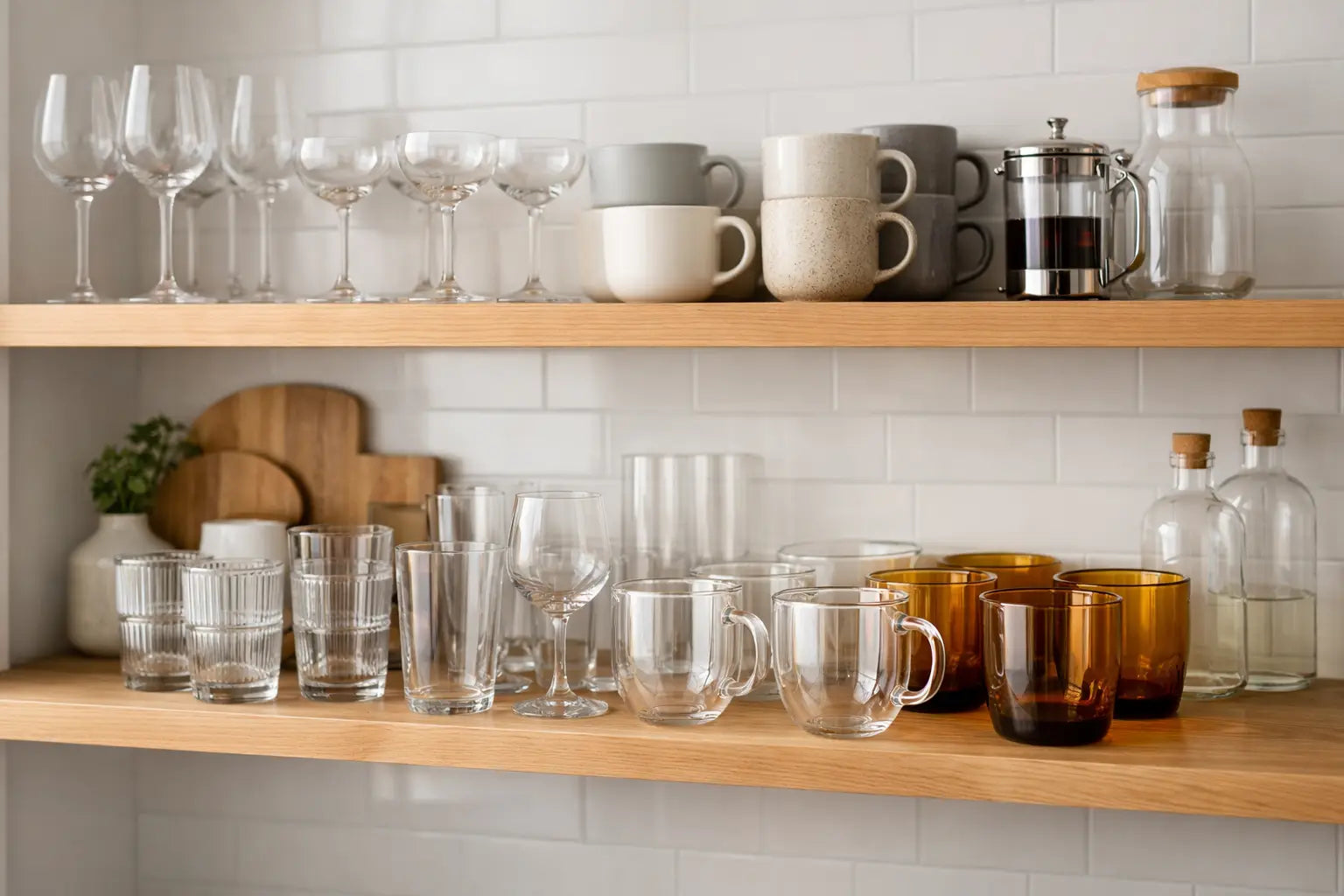
For most homes, the strongest foundation is clear glassware in two or three core shapes, paired with a considered coffee service. Clear vessels reflect daylight without adding visual weight, while porcelain cups introduce a softer, architectural contrast. This combination feels polished but remains practical enough for daily rituals.
A collection-based approach also makes replenishing easier. If a favorite tumbler breaks or your dinner-party guest list grows, you can add to a family of pieces without disrupting the shelf's visual rhythm. For cafés, restaurants, and boutique hospitality settings, this continuity carries through to the guest experience: the beverage service feels intentional from morning espresso to evening cocktails.
Choose Shapes That Read Well From a Distance
On a closed cabinet shelf, tiny decorative details can be charming. On open shelving, they often disappear into clutter. Prioritize silhouettes with enough presence to be recognized at a glance: a generous bowl, a crisp stem, a gently tapered wall, or a low, balanced profile.
Stemware brings vertical elegance
Wine and champagne glasses are especially effective on upper shelves, where their height draws the eye upward and gives the arrangement a lighter feel. Lead-free crystal is a particularly compelling choice because it offers brilliance and clarity without the yellowed cast that can make a shelf look dated. Its fine appearance also elevates the moment of serving, whether the occasion is a weeknight pour or a formal toast.
Reserve stemware for the shelf height that allows it to stand comfortably upright. If you need to store it in a very shallow cabinet or beneath a low shelf, forcing tall stems into the space will create visual tension and make everyday access less pleasant.
Tumblers create a grounded center
Beverage glasses and low cocktail glasses bring weight and versatility to an open display. Their compact shapes anchor a shelf, especially when stacked in a restrained way or arranged in neat rows. Look for glasses with modern geometry and enough capacity to handle water, iced tea, spritzes, and spirit-forward cocktails.
A good tumbler is often the hardest-working piece in the kitchen. Because it is used constantly, it should be easy to reach, comfortable to hold, and durable enough that it does not need to be treated as precious. The visual payoff comes from keeping the group cohesive rather than from choosing the most ornate option.
Coffee cups add warmth and ritual
A porcelain espresso or cappuccino cup with a matching saucer can make an open shelf feel like a small, beautifully organized café. The saucer matters as much as the cup here. It adds a horizontal line, makes the set feel complete, and brings a quiet sense of hospitality to the display.
The Wilshire-style pairing of porcelain cup and saucer works particularly well beside clear glassware because the materials offer contrast without competing. Keep cup handles facing the same direction, and stack saucers only as high as feels stable and easy to separate. Precision should never come at the expense of a relaxed morning routine.
Think About Material in Real Light
The best drinkware for open shelving should suit the light in the room, not merely look good in a product photograph. Clear lead-free crystal catches sun and pendant lighting with a bright, refined clarity. It can make compact kitchens feel more open, especially when the shelving is wood, painted plaster, or a dark finish.
Porcelain has the opposite but equally valuable effect. Its opaque surface creates moments of calm amid reflective glass, grounding the display with softness and color. White porcelain is timeless, but a warm ivory or subtle neutral can be a better fit for kitchens with natural oak, travertine, brass, or cream cabinetry.
Colored glass can be striking, though it requires more restraint. One amber carafe or a small set of smoked tumblers may add depth. A shelf full of unrelated colored pieces, however, can quickly shift from curated to souvenir-like. If color is part of the plan, repeat it at least once elsewhere in the kitchen through linens, ceramics, or artwork.
Build Around Your Actual Drinking Habits
A shelf should present the drinks you serve, not an imagined version of your life. If you make cappuccinos every morning, give those cups the most accessible position. If friends tend to gather for wine and aperitifs, let stemware and versatile cocktail glasses take priority. If your household reaches for water glasses all day, place them where no one has to stretch around fragile pieces.
For a practical home setup, consider displaying enough everyday tumblers for the household plus a few guests, a modest set of wine glasses, and a coffee service that supports the way you brew. Store the overflow elsewhere. This preserves breathing room, which is the element that makes open shelving feel elevated rather than overfilled.
Hospitality buyers can apply the same principle at greater scale. A visible shelf behind a bar or coffee station should showcase the vessels associated with the menu's highest-value rituals. The glassware becomes part of the presentation before a drink is even served, signaling care, quality, and a clear point of view.
Arrange With Breathing Room and Easy Reach
The most photogenic shelf is not always the most useful one. Put your everyday glassware between waist and eye level. Taller, less frequently used pieces can move higher; heavier vessels should stay lower. This protects delicate stems while making the display feel natural to use.
Leave small pockets of negative space between groupings. A row of four wine glasses beside a stack of two saucers and a short cluster of tumblers has more presence than a shelf packed edge to edge. The empty space gives each silhouette room to register.
Avoid mixing too many scales on one shelf. A tiny cordial glass beside an oversized mug and a large pitcher can look accidental unless there is a strong common thread. When in doubt, group like with like: stems together, tumblers together, coffee pieces together. A carafe or small tray can act as a visual pause between categories.
Keep the Display Beautiful Through Use
Open shelves reveal dust, water spots, and mismatched replacements quickly. The answer is not to treat your drinkware as untouchable. It is to choose pieces that invite regular use and establish a light maintenance rhythm. Return glasses to the same zone after washing, polish clear stemware before a gathering, and periodically remove the pieces that no longer support the overall palette or function.
For glassware that is hand-washed, allow every piece to dry fully before placing it back on the shelf. Trapped moisture can leave rings on wood and dull the crisp look of a clear display. If your pieces are dishwasher-safe, resist overstacking them afterward simply because there is room. A little restraint protects both the glass and the design.
The most memorable open shelves do not look staged. They look like the natural result of choosing fewer, better vessels and giving them a meaningful place in daily life. Select drinkware that you want to reach for, then let the shelf make that ritual visible.