Best Glasses for Whiskey Tasting
A great whiskey can feel flatter than it should if the glass gets in the way. When people ask about the best glasses for whiskey tasting, they are usually asking a more interesting question - which shape lets aroma, texture, and presentation come through with the most clarity?
That answer depends on how you taste, what you pour, and how much you care about the visual experience at the table. For a serious nosing session, the ideal glass is not always the most comfortable one for casual sipping. For a design-led home bar or a hospitality setting, the best choice also needs to look composed in the hand and on the surface it sits on. With whiskey, form and function are closely tied.
What makes the best glasses for whiskey tasting?
The key variable is aroma concentration. Whiskey reveals itself through the nose first, and the right bowl shape helps collect volatile compounds rather than letting them disappear too quickly into the room. A narrower rim usually improves nosing, while a wider bowl gives the spirit room to open.
Material matters too, though less than people sometimes assume. Thin, lead-free crystal or fine glass tends to feel more precise at the lip and visually more refined, which can subtly improve the experience. Weight and balance also play a role. If a glass feels clumsy, thick, or top-heavy, it can distract from the ritual.
There is also the issue of pour size. Tasting glasses work best with modest pours, often around half an ounce to one ounce. A vessel that looks elegant with that amount will feel more intentional than one that appears half-empty unless it is filled with a generous pour.
The leading glass shapes for whiskey tasting
The Glencairn glass
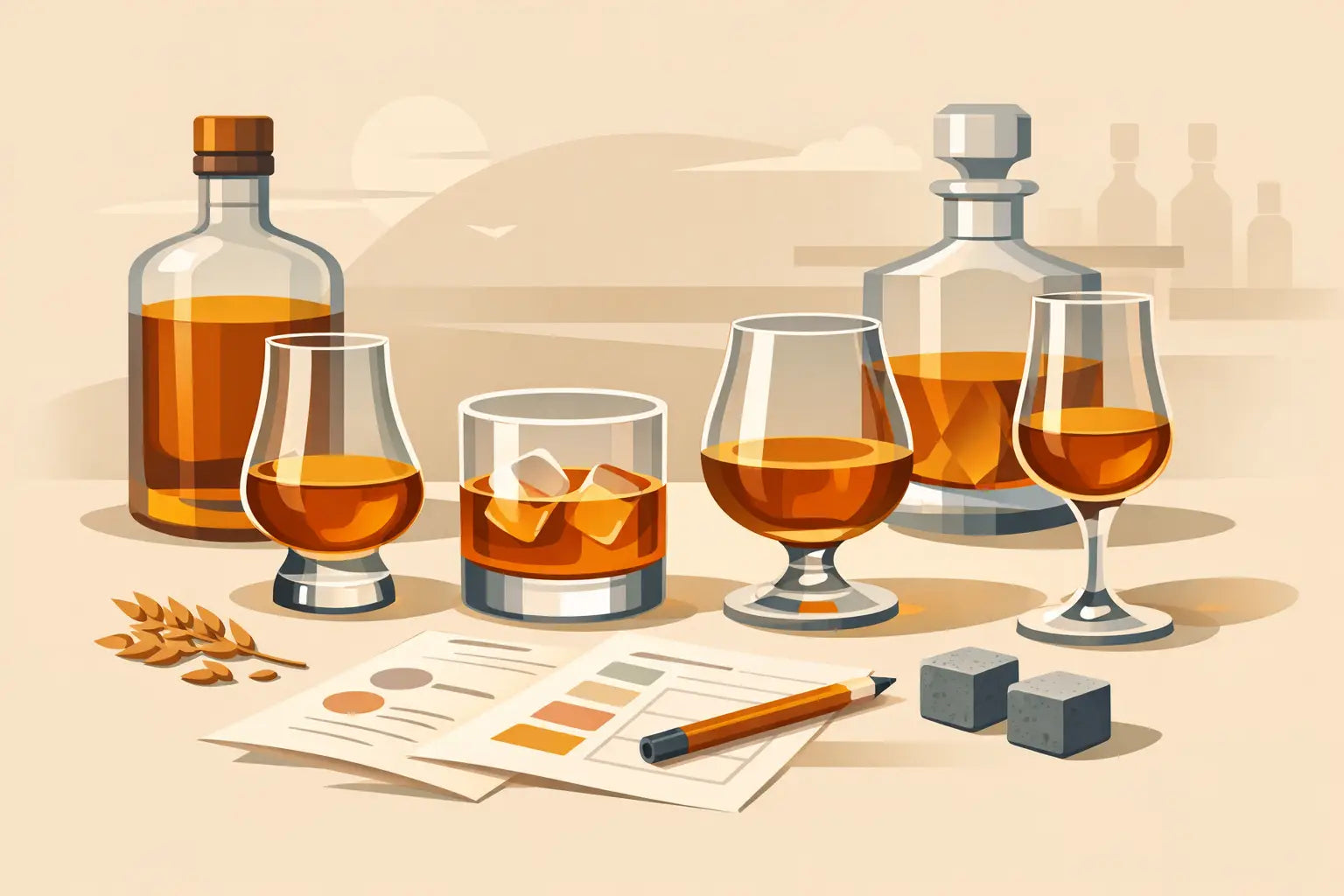
If you want the most widely accepted answer, it is the Glencairn. This is the benchmark tasting glass for a reason. Its tulip-shaped bowl encourages aroma concentration, while the short, solid base makes it stable and easy to hold without warming the liquid too quickly.
For neat pours, the Glencairn is excellent at separating layers in the nose. Vanilla, orchard fruit, char, spice, cereal notes - they tend to appear with more structure than they do in a wide rocks glass. It is especially useful for comparative tastings where you want to move from one whiskey to another and catch differences clearly.
The trade-off is aesthetic preference. Some people love its compact, purposeful silhouette. Others find it a little too technical or too familiar, especially if they want a more elevated tablescape. It is a tasting tool first, even if it has become iconic.
The copita or tulip glass
The copita is arguably even better for nosing than the Glencairn, particularly for experienced tasters. It has a stem and a more elongated tulip shape, which keeps your hand farther from the bowl and brings the aromas toward a narrower opening.
This style can be remarkably expressive with delicate single malts, older whiskeys, and more nuanced pours where you want detail over comfort. The profile feels elegant and almost ceremonial, which appeals to those who see whiskey tasting as a visual ritual as much as a sensory one.
Its downside is practicality. A stemmed glass is less casual, a bit easier to knock over, and not always what guests want for relaxed entertaining. In a busy hospitality environment, it may not be the most efficient choice unless presentation is central to the experience.
The neat glass
The NEAT glass has a distinctive shape that looks unconventional at first, but it is designed to soften ethanol intensity and redirect harsh alcohol vapors away from the nose. For people who find cask-strength pours too aggressive in standard tasting glasses, this can make a real difference.
It is less traditional in appearance, which can be either a strength or a drawback depending on your style. In a modern setting, its shape reads as intentional and design-forward. For a classic whiskey service, it may feel less aligned with the mood.
The whisky snifter
A snifter can work for whiskey, though it is often better for leisurely sipping than disciplined tasting. The broad bowl encourages swirling and gives the spirit space to open, but the rim is usually not as focused as a Glencairn or copita.
That means aromas may feel rounder and softer, but sometimes less precise. If you enjoy richer, fuller bourbon profiles and like a more lounge-oriented experience, a snifter can be very appealing. If you want analytical clarity, there are better options.
The rocks glass
A standard rocks glass is not the best dedicated tasting glass, but that does not make it the wrong choice. It is simply built for a different kind of whiskey moment. Its wide opening disperses aroma quickly, so subtle notes can get lost. For formal tasting, that is a limitation.
Still, a beautifully proportioned rocks glass has value. It feels grounded, visually clean, and versatile enough for neat pours, large-format ice, and casual sipping. For many home drinkers, this is the glass they actually reach for most often. If your whiskey ritual moves between tasting and entertaining, a refined rocks glass may be the smartest all-around addition even if it is not the pure specialist pick.
How shape changes what you taste
The bowl influences evaporation, the rim influences concentration, and the lip affects how the whiskey lands on the palate. A narrower opening can make aromas more vivid, but if it is too tight, high-proof whiskey may feel sharp or closed off. A wider opening creates more air contact, which can help some pours relax, though it also sacrifices focus.
This is why there is no single perfect answer for every bottle. Peated Scotch, high-rye bourbon, soft Irish whiskey, and mature Japanese whisky do not always show best in the same vessel. A heavily peated dram may benefit from a glass that contains and organizes its smokiness. A softer whiskey might need a little more openness to avoid feeling muted.
Choosing the right glass for your kind of tasting
If you host side-by-side tastings, use a tulip-shaped glass. It will give you the clearest read on aroma and structure. If you tend to pour one thoughtful dram at the end of the evening, your priorities may shift toward comfort, weight, and visual presence.
For home entertaining, presentation matters more than enthusiasts sometimes admit. The glass is part of the atmosphere. A sharply designed vessel in clear, lead-free crystal can make the pour feel curated before anyone takes a sip. That is not superficial. Whiskey is an experience product, and the vessel frames the experience.
For bars, restaurants, and hospitality spaces, the calculation expands. You need elegance, but also stackability concerns, durability, replacement cost, and consistency across service. A specialized tasting glass can be worth it for flights and premium pours, while a refined rocks glass may carry more of the daily workload.
Design details worth paying attention to
Thin rims tend to feel more polished than heavy rolled edges. Clarity matters because whiskey's color is part of the visual story, especially under warm lighting. Proportion matters too. A tasting glass should not feel oversized, and a rocks glass should not look bulky unless that is a deliberate aesthetic choice.
Balance is often overlooked. A glass that sits confidently in the hand adds to the sense of control and ease. Modern geometry, restrained detailing, and a silhouette that looks intentional on a tray or bar cart can elevate the entire ritual. This is where design-forward drinkware earns its place. The right glass does not compete with the whiskey. It presents it.
So what are the best glasses for whiskey tasting?
If you want the clearest answer, start with a Glencairn or copita for true tasting. Those shapes are best at capturing aroma and helping you distinguish detail from one pour to the next. If you are especially sensitive to alcohol burn, the NEAT glass is worth considering.
If your tasting ritual is less formal and more lifestyle-driven, a sophisticated rocks glass still has a place, especially for neat pours that transition naturally into slow sipping. Brands like Angeleno Drinkware understand that a glass should perform well and look composed in the setting around it, whether that setting is a quiet night at home or a polished hospitality program.
The best whiskey glass is the one that matches your intention. If you are evaluating, choose focus. If you are hosting, choose presence. If you want one collection that feels refined every time it leaves the shelf, choose a shape you will actually enjoy using. Whiskey asks for attention, and the right glass rewards it.